
Designing Better Business: Why Purpose Matters Beyond the Workplace

Every year, Better Business Day brings together organisations across the UK to celebrate the idea that business can be a force for good. Led by the B Corp movement, it's an opportunity to champion businesses that are committed not only to commercial success but also to creating positive social and environmental impact.
At AGC, that's a philosophy we share. As a certified B Corp, we're committed to balancing purpose with profit, and we believe that great interior design has an important role to play. The spaces we design shape how people feel, collaborate and perform, while the choices we make around materials, longevity and sustainability can have a lasting impact on both our clients and the wider environment.
We've invited guest author Fran Page from Good Better, to share her perspective on why purpose-led business matters more than ever and how organisations of all sizes can help build a better future.


Fran Page, B Corp Consultant, Good Better.
Confession time... I used to measure business success by profit alone. That’s pretty much all I thought about during the first decades of my professional life. Token charitable initiatives and pro-bono work aside, I’d persuaded people to spend their hard-earned cash on everything from shockingly expensive handbags and whiskey to diesel-guzzling cars and Botox.
That all changed about 12 years ago when I was heading up marketing at a mission-driven tech startup called Headspace in Los Angeles. They wanted to do good alongside doing well.
From Ancient India to Victorian Reformers
I dived into history and learned that the very first evidence of corporations - dating back thousands of years to the ancient Indian Shreni - showed they were all given a license to operate as long as they were also benefiting society in some way. They needed a purpose to make a profit.
This continued through the Romans, Medieval guilds and charters, Victorian railroad companies, and pioneering UK social-reforming businesses such as Cadbury’s. Even the idea of public shareholding was created by Elizabeth I in 1555 as a way of democratizing corporations—of making investment in them accessible to broader society.
Where did it all go wrong?
You could say it all went wrong in the 1950s with the Mad Men-fueled growth of mass consumerism, followed by Milton Friedman’s assertion that the sole responsibility of business is shareholder profit maximization, and Gordon Gekko’s infamous 1980s declaration: “Greed is good!”
But as far back as 1906, The Devil’s Dictionary defined the corporation as “an ingenious device for obtaining profit without individual responsibility.” One hundred years later, The Companies Act 2006 further cemented shareholder returns as the legal purpose of company directors. That law is still in place, and it allows companies to disregard their impact on stakeholders (employees, the planet, customers, and the community).
Making ‘Force for Good’ the Legal Baseline
On 9th June, Better Business Day saw business leaders and policymakers descend on Westminster to demand a change to company law by adopting the Better Business Act (BBA), launched by B Lab UK - the nonprofit powering the B Corp movement.
Led by co-chairs Mary Portas OBE and Douglas Lamont (CEO of Tony’s Chocolonely, the fastest-growing chocolate brand in the world), they are campaigning for an amendment that would legally empower company directors to align shareholder interests with those of wider society and the environment. This ensures they are not focused on profit alone - a concept known as stakeholder governance.
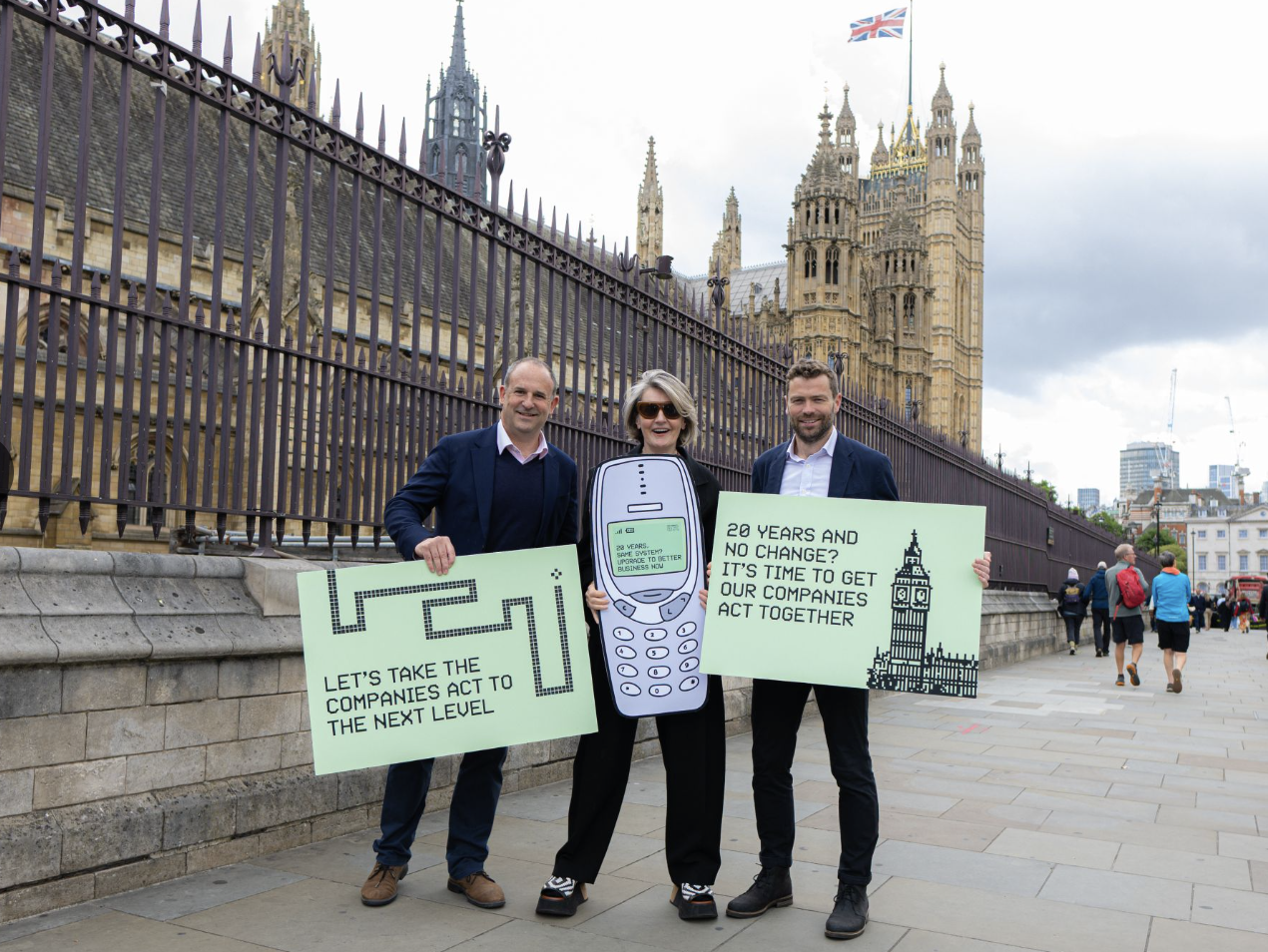
(Co-Chairs of the Better Business Act, Mary Portas & Douglas Lamont, with Chris Turner, CEO of B Lab UK)
The Proof is in the Profits
For too long, considering stakeholders has been seen as a burden to business. In reality, it is a less risky, financially sensible way of running a company.
Douglas Lamont’s speech in Westminster outlined how stakeholder governance actually benefits shareholders, as purpose-led businesses are more financially sustainable. Research repeatedly equates stakeholder governance with long-term profitability. Furthermore, B Lab’s 10-year report on the movement showed that B Corps are vastly outperforming non-B Corps:
20% increase in turnover vs. the national average of 3% (UK SMEs, 2024–2025)
11% employee headcount increase vs. the national average of 2% (UK SMEs, 2024–2025)
18% more growth funding secured from external investors than other UK businesses over the last 10 years
As Yvon Chouinard, founder of iconic B Corp Patagonia, famously quipped: “Every time I do the right thing, I seem to make money.”

Time for a System Upgrade
All B Corps are required to adopt the legal framework advocated for by the BBA. Let’s celebrate B Corps for reminding us that business can be a force for good in society, and for elevating companies that create benefits for ALL STAKEHOLDERS.“

“As a B Corp, we’re already legally and operationally embracing stakeholder governance, but we’re now urging ALL UK companies to join the Better Business Coalition to make business a force for good.”
Stella Gittins, Co-Founder, AGC
How you can help
Join the coalition today, it only takes a minute! http://www.betterbusinessact.org
Write to your MP then share the link with colleagues and friends to amplify our voice.
Spread the word with these tools and resources.
USA
1 Crosby St, 3rd Floor,
New York,
NY 10013
T: +1 917 957 9076
E: info@agofc.com
Global HQ & Europe
AGC Townhouse
1 Gower Street
London
WC1E 6HD
United Kingdom
Emirates
The Bureau Business Center,
Gold & Diamond Park,
Building 6,
Dubai, United Arab Emirates
T: +971 58 594 5346
E: info@agofc.com